


What if the breathtaking mountain acreage you just secured was legally unbuildable because of the very soil beneath your feet? It’s a scenario that haunts many land buyers, especially since North Carolina’s wastewater regulations underwent their most significant overhaul in thirty years on January 1, 2024. Most investors still search for a perk test for land in NC; however, relying on outdated terminology in this high-stakes market can lead to expensive misunderstandings. You deserve absolute certainty before you sign a contract, and understanding the nuances of modern soil morphology is the only way to ensure your mountain estate remains a viable asset.
We recognize that the technical jargon used by health departments can feel overwhelming when you’re focused on your vision for the land. This guide promises to clarify the transition from simple drainage tests to comprehensive soil evaluations, giving you the expert insight needed to protect your investment. You’ll learn the specifics of the current three-permit system, the impact of regional geography on your build site, and a professional checklist for your due diligence period. We’re here to provide the clarity and confidence required to navigate your next land purchase with ease.
Key Takeaways
- Understand why North Carolina transitioned from simple drainage checks to sophisticated soil morphology evaluations and what this means for your property’s development potential.
- Learn the critical steps of the modern three-permit process to ensure your perk test for land in NC translates into a permanent Operation Permit.
- Navigate the unique challenges of mountain acreage, including steep slope limits and shallow bedrock that often dictate advanced septic system designs.
- Secure your investment by implementing specific septic contingencies in your purchase contract to avoid the risk of acquiring unbuildable land.
- Leverage local expertise to bridge the gap between technical soil data and a successful luxury estate closing in the High Country.
What is a Perk Test for Land in NC? (Soil Suitability 101)
Buying land in the North Carolina mountains is an exercise in both vision and due diligence. While many buyers still ask for a perk test for land in NC, it’s vital to understand that the state’s regulatory environment has evolved far beyond the simple tests of the past. In our rural High Country communities, municipal sewer lines are a luxury, not a standard. This makes a passing soil evaluation the absolute gatekeeper for your project. Without it, obtaining a residential building permit is legally impossible. The primary goal is simple: determining if your specific acreage can safely treat wastewater on-site without contaminating the groundwater that sustains our region.
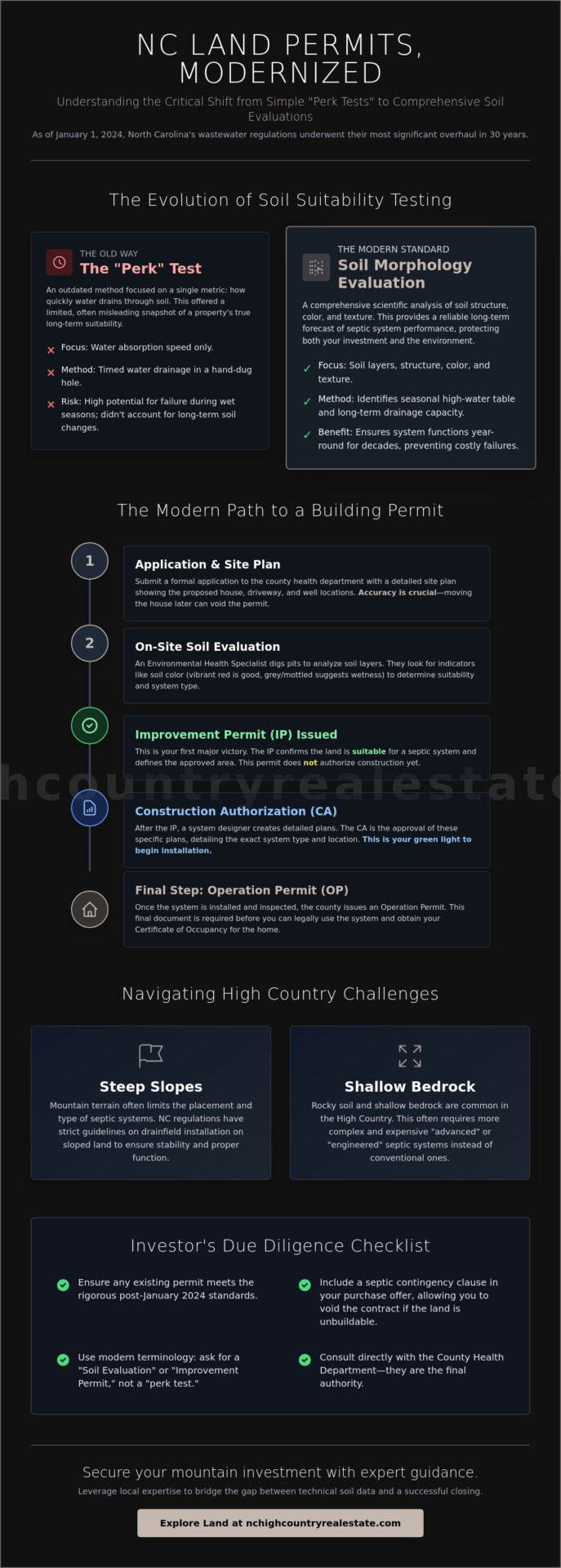
The shift toward soil morphology—analyzing the structure, color, and texture of the earth—provides a more reliable long-term outlook for your luxury estate. North Carolina’s wastewater rules, specifically 15A NCAC 18E, represent the most significant regulatory overhaul in over 30 years. These rules ensure that your septic system won’t just work on the day of the test, but will continue to function through decades of mountain weather. Relying on outdated terminology can lead to costly mistakes. You need to know exactly what the state is looking for before you commit to a purchase.
Perc Test vs. Soil Evaluation: The Key Differences
Historically, a Percolation test was essentially a race against the clock. Technicians measured how quickly water drained through a hand-dug hole to see if the soil was porous enough. Modern North Carolina soil evaluations are far more sophisticated. Instead of just timing water, Environmental Health Specialists examine distinct soil layers to identify the seasonal high-water table. This is the highest level the groundwater reaches during the wettest part of the year. If your system is placed too deep, it risks failure during heavy rains.
Soil color tells a vivid story to a trained specialist. Vibrant, uniform red soil typically suggests well-oxidized, well-draining earth that’s perfect for a traditional system. Conversely, grey or mottled soil often signals “wetness” or poor drainage. These indicators help specialists determine the exact depth and type of system your land requires. It’s a precise science that protects both your home and the local environment.
The Legal Requirement for Septic Permits in NC
Your path to building involves two critical documents: the Improvement Permit (IP) and the Construction Authorization (CA). The IP is your first major win; it confirms the land is suitable for a septic system and identifies the general area where it can be installed. However, the IP doesn’t allow you to start digging. You must also secure a Construction Authorization, which details the specific system design and its exact location on your site plan.
Don’t trust a handshake or a yellowed piece of paper from 1995. An “expired” perk test for land in NC is a significant red flag for any savvy investor. Permits issued under old regulations may not meet the rigorous standards implemented in 2024. Your local County Health Department is the final authority in the High Country. Their stamps of approval are the only ones that matter when it’s time to break ground on your mountain retreat.
How the NC Soil Evaluation Process Works: Step-by-Step
The journey from a raw plot of land to a permitted building site is a structured, multi-week process. It begins with a formal application and ends with a legal document that dictates exactly where and what you can build. While the timeline varies based on seasonal demand and county staffing, the physical evaluation remains the most critical hurdle. Understanding the mechanics of a perk test for land in NC allows you to manage expectations and coordinate with your design team effectively. You aren’t just paying for a permit; you’re investing in a professional analysis of your property’s long-term infrastructure.
Applying for the Evaluation
Your first step involves submitting a formal application to the environmental health department in your specific county, such as Watauga, Ashe, or Avery. You’ll need to provide a detailed site plan that illustrates your proposed house footprint and driveway location. Accuracy is paramount here. If you move the house fifty feet after the test, the original permit may become void. We strongly advise clients to Investigate Before You Invest by having property corners and proposed structures clearly flagged before the specialist arrives. This preparation ensures the evaluator focuses on the most desirable build sites on your acreage.
The Field Inspection: What They Are Looking For
While some evaluations use a hand auger, we often recommend the “backhoe pit” method for high-end residential projects. This involves digging several pits, roughly five to six feet deep, to expose the full soil profile. Seeing the undisturbed layers allows a Licensed Soil Scientist (LSS) or county official to identify “restrictive horizons,” such as solid rock or dense clay, that could impede drainage. Saprolite is the chemically weathered rock that retains the appearance of solid stone but can be dug with machinery, often found beneath the soil layers in the Blue Ridge. Identifying the depth of this material is essential for determining which septic technologies are viable for your site.
Understanding the Results: Pass, Fail, or ‘Provisionally Suitable’
A “Suitable” rating is the ideal outcome, but “Provisionally Suitable” is a common reality in our rugged terrain. This middle-ground rating means the land can support a system, but it may require specialized engineering or alternative designs, such as a pre-treatment unit or a pump system. The final report will specify how many bedrooms the soil can support. If you planned a five-bedroom mountain retreat but the soil only supports three, you’ll need to adjust your architectural plans accordingly. When reviewing land and acreage sales, always ask for the specific bedroom count listed on the Improvement Permit to ensure the land matches your lifestyle goals.
High Country Challenges: Slope, Rock, and Mountain Septic
Building a luxury estate in the Blue Ridge Mountains requires a different strategic approach than developing a coastal lot. In the flatter regions of the state, drainage is the primary concern. In the High Country, however, a perk test for land in NC is often a battle against gravity and geology. The very features that make our region desirable, such as dramatic elevation and rocky outcroppings, are the same factors that complicate septic design. You must account for slope and soil depth before you fall in love with a particular view.
Topography dictates the viability of your project. North Carolina regulations generally consider slopes between 15 and 30 percent as “Provisionally Suitable,” provided the soil morphology is correct. Once you exceed a 30 percent grade, most traditional systems are no longer an option. If your building site is too steep, wastewater won’t filter properly through the soil; it will simply travel along the slope surface. This physical reality makes certain view lots functionally unbuildable without expensive, engineered alternative systems. In our region, roughly 50 percent of the population relies on septic, making these evaluations the most critical part of your land investment. Buyers seeking unrestricted land for sale in the NC mountains should pay particular attention to these slope and soil constraints, as they can significantly affect which counties and parcels offer true development flexibility.
Topography and Drainage in the Blue Ridge
Your drain field layout must work in harmony with the natural contours of the land. In mountain municipalities like Boone and Blowing Rock, specialists look for long, linear sections of land that can accommodate lateral lines. It’s also vital to remember the “repair area” requirement. North Carolina law typically requires you to set aside enough space for a second, backup septic system. This means you effectively need twice the suitable soil area you might initially expect. Managing surface runoff is another critical factor. We ensure that water from your driveway or roof doesn’t flood the drain field, which could lead to premature system failure or environmental issues.
Dealing with Shallow Bedrock
The “two-foot rule” is a non-negotiable standard in the High Country. State regulations require at least 24 inches of suitable, vertical soil separation between the bottom of your septic trenches and any restrictive horizon, such as solid rock. On many of our most exclusive ridges, the soil is thin. A lot with a panoramic vista might only have twelve inches of soil before hitting granite. This doesn’t always mean the land is useless. A Licensed Soil Scientist can often identify small pockets of deeper soil on a rocky ten-acre tract that a standard county inspection might miss. If traditional gravity systems fail, we often turn to Low-Pressure Pipe (LPP) or drip irrigation systems. These have become the dominant installation types in the Piedmont and mountain regions due to challenging terrain.
Land Due Diligence: Protecting Your Investment Before Closing
Buying land is more than just a transaction; it’s a strategic acquisition of potential. In the High Country, your due diligence period is the most critical window for risk mitigation. A perk test for land in NC should never be an afterthought or a verbal assurance from a seller. It must be a legally binding component of your purchase agreement. We’ve seen many investors rely on a neighbor’s successful permit as proof of their own land’s viability, only to find that soil conditions change drastically within a few dozen feet. Soil is a localized variable, and assuming uniformity is a high-stakes gamble you don’t need to take.
The ‘Septic Contingency’ in Your Purchase Contract
A standard due diligence period in North Carolina typically lasts between 30 and 60 days. This timeframe is often tight when you consider that county health departments may have backlogs of several weeks for field visits. Your contract should include a specific septic contingency that allows you to terminate the agreement if the soil evaluation does not meet your specific requirements. This isn’t just about a “pass” or “fail” result. You must specify the number of bedrooms required for your vision. If the soil only supports a two-bedroom cabin but you’ve designed a four-bedroom luxury estate, the land no longer serves your investment goals. Negotiating who bears the cost of a private soil scientist versus waiting for the county can be a pivotal part of your initial offer strategy. For a comprehensive overview of every step involved, review our definitive checklist for buying land in NC to ensure no critical detail is overlooked during your due diligence period.
Red Flags to Watch For on Mountain Acreage
While a professional evaluation is essential, you can spot potential issues during your initial site visit. Be wary of areas with lush, bright green vegetation that stands out from the surrounding flora. This often indicates a high water table or poor drainage. Visible rock outcroppings near your desired build site are another sign that you may face the “shallow to rock” challenges common in our region. Additionally, when you are researching how to buy unrestricted land, pay close attention to old, existing structures. Historically, some rural properties utilized “straight pipes” that discharged wastewater directly into the environment. These are illegal; they will require a complete, modern system installation to bring the property up to current standards before any new construction can begin.
Protecting your capital requires a meticulous approach to every detail of the land. If you are currently exploring land and acreage sales in Watauga or Avery counties, ensure your contract includes these vital protections to keep your mountain investment secure.
Why Local Expertise Matters for High Country Land Sales
Navigating the acquisition of mountain acreage requires a sophisticated understanding of both the land and the local regulatory climate. While a perk test for land in NC provides the technical baseline for development, the success of your project often hinges on the professional relationships your agent maintains. At NC High Country Real Estate, Lori Eastridge acts as a strategic partner, bridging the gap between complex soil data and your long-term lifestyle goals. We understand that a “suitable” soil report is only one piece of the puzzle. You need a representative who knows which private soil scientists are most familiar with the unique rock formations in Watauga County and how to effectively communicate with environmental health officials to keep your project moving forward.
Our approach is rooted in transparency and meticulous attention to detail. We don’t just show properties; we analyze them for long-term viability. Whether you are seeking a legacy luxury estate or a high-yield investment cabin, we match your vision with the physical capabilities of the earth. In a market where 15A NCAC 18E regulations have redefined the standards for wastewater treatment, having a localized, intimate perspective is your greatest advantage. We ensure that every detail of your due diligence is handled with the discretion and professionalism that high-stakes transactions demand.
Beyond the Soil: A Holistic Approach to Land
A truly successful land purchase considers the entire infrastructure of the site. Beyond the septic evaluation, we coordinate the assessment of road access, power connectivity, and well-drilling potential. These elements must work in concert to create a functional build site. For those who decide that building from scratch is too complex, we also offer a curated selection of homes for sale in Boone NC that already feature permitted and inspected systems. Our bespoke consultancy ensures that you aren’t just buying a plot of dirt; you’re securing a foundation for your future in the Blue Ridge Mountains.
Start Your High Country Journey Today
Results-driven advocacy is the hallmark of our firm. We take pride in providing a clear, logical path from your initial inquiry to a confident closing. Our deep roots in the region allow us to provide a level of service that standard agencies simply cannot match. If you are ready to explore the diverse opportunities in Jefferson, West Jefferson, or the surrounding municipalities, we invite you to leverage our expertise. Contact Lori Eastridge today for a personalized land acquisition strategy. Let us provide the professional shorthand and local dominance required to secure your piece of the High Country with absolute certainty. Your mountain investment deserves nothing less than excellence.
Secure Your High Country Future
The evolution of North Carolina’s wastewater regulations means that securing a perk test for land in NC is no longer a simple checkbox on a to-do list. It’s a sophisticated analysis of soil morphology that determines the very foundation of your property’s value. You’ve learned how slope limits and shallow bedrock can shift a project from a standard build to an complex engineered challenge, making professional due diligence non-negotiable. Protecting your capital in this market requires more than just a passing permit; it demands a strategic understanding of how the land functions under the surface. Before you finalize any acquisition, consulting a thorough checklist for buying land in NC can help you confirm that every regulatory and site-specific requirement has been addressed.
Lori Eastridge brings deep local knowledge and specialized expertise as a Licensed Broker to every transaction. As your strategic partner for luxury and investment acquisitions, she ensures that every mountain-specific buildability factor is addressed with precision and transparency. Whether you’re searching for a secluded ridge or an expansive estate, we’re here to provide the localized insight you need to move forward with confidence.
Secure your mountain legacy; contact Lori Eastridge for expert land guidance today.
Your vision for a mountain retreat deserves a partner who values excellence as much as you do. We look forward to helping you find the perfect piece of the Blue Ridge with total peace of mind.
Frequently Asked Questions
How much does a perk test cost for land in NC?
Costs depend on the complexity of the site and the specific county fees. While simple evaluations might start around $300 for hand-dug tests, professional soil evaluations for luxury mountain sites often range between $750 and $1,900 according to industry data. These figures typically exclude the separate county permit fees, which often fall between $200 and $800 depending on the municipality.
How long is a North Carolina perk test/Improvement Permit valid?
An Improvement Permit issued after a successful soil evaluation is valid for five years in North Carolina. If the permit expires before you begin construction, you’ll need a re-evaluation under current regulations. Because rules like 15A NCAC 18E recently changed, older permits may not be easily renewed without a fresh look at the soil morphology to ensure compliance with modern standards.
Can you build on land that failed a perk test in NC?
Building on land that has received an unsuitable verdict is difficult but not always impossible. You have the option to appeal the decision or hire a private Licensed Soil Scientist to find a more suitable pocket of earth on the property. In many High Country cases, land that fails for a traditional gravity system can still support a home using an alternative engineered system like a drip or LPP installation.
Who performs a perk test in North Carolina?
Evaluations are typically conducted by Environmental Health Specialists from the county health department. Many developers and luxury land buyers now hire private Licensed Soil Scientists or Authorized On-Site Wastewater Evaluators to expedite the process. These private professionals provide a high level of expertise and can often navigate complex mountain terrain more quickly than county staff alone, which is vital for meeting tight closing deadlines.
What is the difference between a perc test and a soil evaluation?
A traditional percolation test measures the speed at which water drains through a hole; however, North Carolina now requires a comprehensive soil evaluation. This modern approach analyzes soil morphology, including texture, structure, and color, to determine the seasonal high-water table. It is a more scientific method that ensures long-term system reliability rather than just providing a snapshot of drainage speed on a single day.
How many holes are dug for a perk test?
Specialists typically dig between three and five test pits or auger borings to get a complete view of the proposed drain field. For a perk test for land in NC on complex mountain sites, more holes may be necessary to identify the most suitable soil pockets. Using a backhoe to dig larger pits is often preferred for high-end estates as it allows a clearer view of the soil profile and restrictive rock layers.
Does a perk test affect the value of land?
A confirmed Improvement Permit significantly increases the market value and liquidity of a property. Land that is ready to build commands a premium because it removes the primary risk for the buyer. Conversely, acreage without a successful perk test for land in NC is often viewed as a speculative investment, which can lead to lower offers and longer times on the market during the resale process.
What is a ‘repair area’ in an NC septic permit?
A repair area is a designated section of your property that must remain undisturbed to serve as a backup site for a future septic system. North Carolina law requires this space to ensure that if your primary system fails, there is a secondary location with suitable soil ready for use. This requirement effectively means you need double the amount of suitable soil than the primary system alone requires for your build.
