


The Reality of Land for Sale in North Carolina Mountains in 2026
The allure is undeniable. A sweeping Blue Ridge vista, the promise of crisp mountain air, and a legacy carved from the ancient Appalachian landscape. But in the dynamic 2026 market, securing your ideal parcel of land for sale in the North Carolina mountains requires more than vision—it demands a strategic mindset. The current market reflects a powerful demand for privacy, sustainable living, and a genuine connection to nature. This has made pristine acreage a highly sought-after asset.
However, it is crucial to understand a core principle of High Country real estate: raw land is not always ready land. A stunning view doesn’t guarantee a viable building site. We believe in validating the powerful emotional appeal of the mountain lifestyle while grounding your search in the rigorous logic needed for a sound investment. Here, land is a multi-dimensional asset defined by its view, slope, access, and soil—and each element requires expert evaluation.
Why the High Country is Different
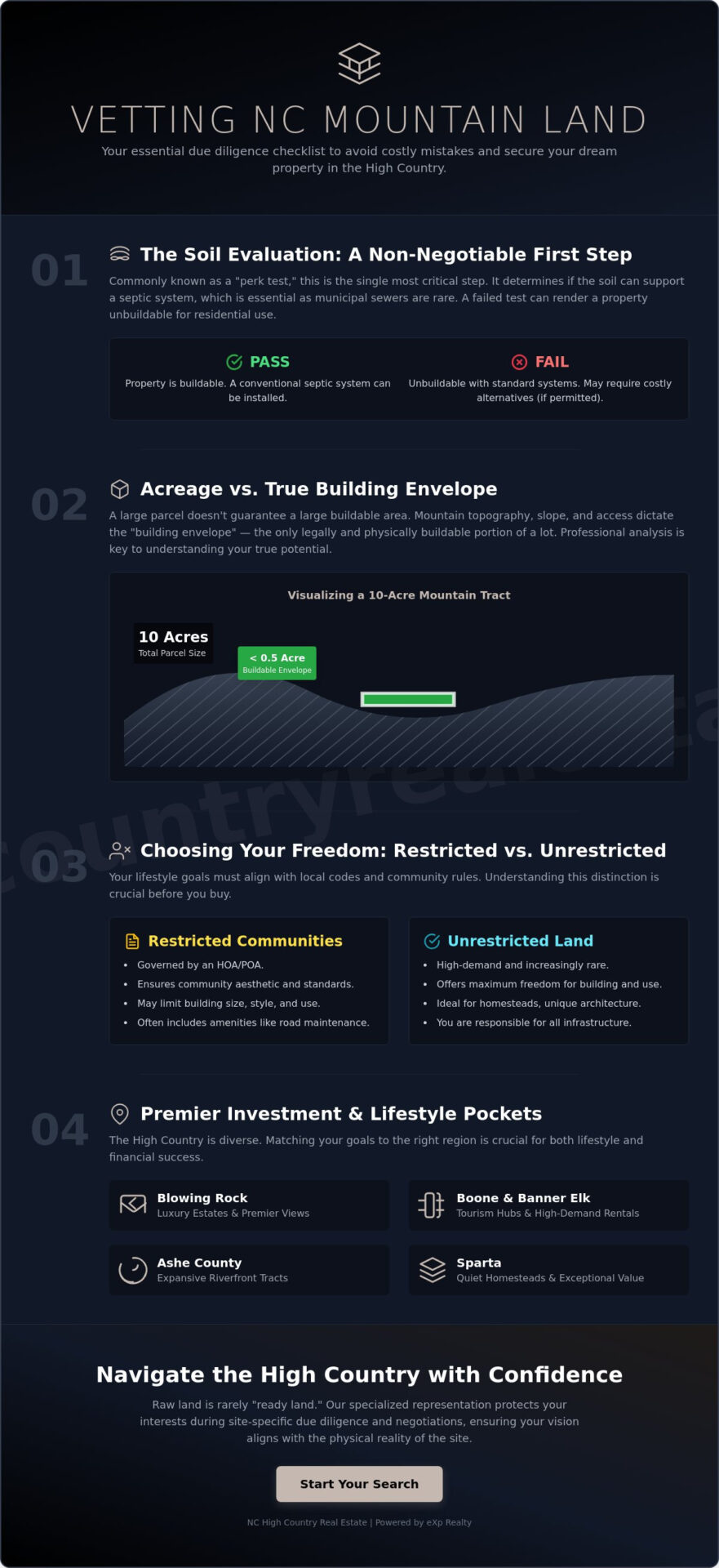
Purchasing land in the Blue Ridge Mountains is fundamentally different from a transaction in a flat-land suburb. Standard real estate practices often fail to account for the unique challenges and opportunities presented by our rugged terrain. The “Slope Factor,” for instance, dramatically impacts your usable, buildable area. A steep grade can shrink a 10-acre parcel to a mere half-acre building site, a reality that requires a seasoned eye to identify.
This is where local expertise becomes non-negotiable. Navigating the specific ordinances, soil types, and microclimates of regions like Ashe and Watauga counties is a science. An agent who understands the nuances between a south-facing slope in Boone and a riverfront lot in Jefferson can protect you from costly missteps and uncover hidden value.
Defining Your Goals: Investment vs. Homestead
Before you begin your search, it’s essential to clarify your primary objective. Are you seeking a long-term investment through land banking, waiting for appreciation? Or are you planning for immediate residential construction—your family homestead or a luxury mountain retreat? Each goal dictates a different search strategy.
For those focused on returns, a strategic approach to NC real estate investment might prioritize parcels with future development potential or unique features. Conversely, a future homeowner must prioritize buildability, utility access, and lifestyle alignment. Your goals will help determine the ideal location, whether it’s the tourism-heavy hub of Boone or the quiet, pastoral landscapes of Sparta.
Technical Due Diligence: How to Vet Mountain Acreage
In the North Carolina mountains, you aren’t just buying land; you are buying a building site. The two are not always the same. Performing meticulous technical due diligence is the most critical phase of your acquisition process. This is where a dream with a view becomes a viable plan for a home. We’ve distilled this complex process into five essential steps.
- Soil & Septic Feasibility: The first and most important step is evaluating the soil. A soil evaluation, commonly known as a perk (percolation) test, determines if the ground can support a septic system. Without a passing perk test, a property is often unbuildable for a primary residence.
- Topography Analysis: A topographical map is your best friend. It reveals the property’s slope, identifying the flat, stable areas suitable for a foundation. A 10-acre lot might look expansive, but only a small fraction—the “building envelope”—may be practical for construction.
- Water Sourcing: Most rural mountain properties rely on private wells. Understanding the geology of the Blue Ridge is key, as drilling can be complex and deep. Verifying the likelihood of hitting water at a reasonable depth is a crucial part of your risk assessment.
- Road Access Verification: How will you get to your property? It’s vital to confirm whether access is via a state-maintained road or a private drive. If it’s private, a Road Maintenance Agreement (RMA) should be in place to cover upkeep and snow removal. The cost of paving a long, steep driveway can also be a significant hidden expense.
- Utility Proximity: Never assume utilities are at the property line. The “last mile” cost to run power and, increasingly, fiber optic internet can be substantial. Confirming proximity and extension costs with local providers is a non-negotiable step.
The Perk Test and Septic Systems
A failed perk test can terminate a land deal, and for good reason. It signifies that the soil cannot safely absorb and filter wastewater. The health department issues septic permits based on these tests, specifying the number of bedrooms a system can support (e.g., a 3-bedroom vs. 4-bedroom permit). This directly limits the size of the home you can build. While alternative systems like drip irrigation or mound systems exist for challenging soils, they come at a significantly higher cost and require specialized installation.
NC Septic Priority: In North Carolina, it’s wise to make your purchase offer contingent on obtaining a septic permit. This allows you to conduct the necessary soil evaluations during your due diligence period, ensuring the land is suitable for your building plans before you close the deal.
Topography and Building Envelopes
Reading a topo map helps you visualize the land without ever setting foot on it. The closer the contour lines, the steeper the terrain. You’re looking for wider gaps between lines, which indicate gentler slopes or benches ideal for a home site. The building envelope is the specific, legally buildable portion of a lot, often defined by setbacks, easements, and topographical constraints. High-elevation construction on steep slopes requires more complex foundations and extensive retaining walls, which directly impacts your budget.
Access and Infrastructure
There’s a critical difference between physical access (a visible driveway) and deeded access (a legal right to use it). You must verify that your right to access the property is legally recorded in the deed. For shared private roads, a well-drafted Road Maintenance Agreement (RMA) is essential for avoiding future disputes with neighbors over costs. When considering remote parcels in areas like Elk Park, it’s also imperative to contact the local electric co-op and internet providers to get a firm quote on the cost of extending service to your chosen building site.
Unrestricted vs. Restricted Land: Choosing Your Freedom
In the 2026 market, “unrestricted land” is one of the most sought-after categories for buyers of land for sale in the North Carolina mountains. This designation offers the ultimate freedom, but it’s important to understand the full spectrum of property regulations. On the other end are managed communities governed by Covenants, Conditions, and Restrictions (CC&Rs) and a Homeowners Association (HOA).
The choice comes down to lifestyle. An HOA may provide valuable services like road maintenance, snow removal, and shared amenities, which can be a significant benefit. However, this comes with rules that dictate home size, style, and use. In between, you’ll find properties with “light restrictions,” which aim to protect property values (e.g., no mobile homes) without micromanaging your life.
The Appeal of Unrestricted Acreage
True freedom is the primary draw of unrestricted land. It means you have the liberty to build a tiny home, raise farm animals, park an RV, or construct a home with unique, non-traditional architecture. This level of autonomy is increasingly rare and highly valued. Ashe County, in particular, has become a primary hub for buyers seeking this type of mountain freedom. For those serious about this path, understanding the nuances is key. You can learn more in our dedicated strategic guide to buying unrestricted land.
Navigating Managed Communities
For those who prefer a more structured environment, a managed community can be an excellent choice. When considering a property with an HOA, it’s crucial to review the bylaws carefully. Look for key rules regarding minimum square footage requirements, restrictions on short-term rentals, and architectural guidelines. In luxury markets like Blowing Rock and Banner Elk, gated communities offer an added layer of security and exclusivity that enhances property value. These restrictions, while limiting, often ensure a consistent aesthetic and protect the long-term resale value of high-end estates.
Regional Spotlights: Where to Buy in the High Country
The North Carolina High Country is not a monolith. Each town and county offers a distinct character, lifestyle, and type of land. Aligning your goals with the right location is a critical step toward a successful purchase.
Boone and Blowing Rock: The Luxury Core
As the region’s commercial and cultural hub, Boone and its prestigious neighbor, Blowing Rock, command premium pricing. Proximity to Appalachian State University and the Blue Ridge Parkway makes this area a prime target for those seeking convenience and luxury. Here, the market is dominated by view-driven lots in upscale gated communities with high-end infrastructure already in place. If you’re looking for land with access to fine dining, shopping, and cultural events, this is your starting point. You can explore a focused overview in our buyer’s guide to land for sale in Boone, NC.
Ashe County: The “Coolest Corner” for Acreage
Known as the “Coolest Corner” of North Carolina, Ashe County (including Jefferson and West Jefferson) is the epicenter for those seeking larger acreage and a more rural lifestyle. The historic New River meanders through the county, creating high demand for waterfront land. West Jefferson offers a charming downtown with a vibrant arts scene, providing a perfect blend of town and country. This is where you are most likely to find expansive 20+ acre tracts ideal for private family estates or equestrian properties.
Banner Elk to Beech Mountain: High Elevation Haven
For those drawn to high-elevation living and four-season recreation, the corridor from Banner Elk to Beech Mountain and Sugar Mountain is unparalleled. Building above 4,000 feet presents unique challenges, including harsh weather, rocky terrain, and steep slopes, but the rewards are breathtaking, panoramic views. This market is heavily focused on sites for seasonal vacation homes, with strong potential for short-term rental income due to the proximity of the ski resorts.
The Path to Closing: Financing and Expert Representation
Securing your mountain property culminates in two final, critical stages: financing and closing. The right professional guidance during this phase is essential for a smooth and successful transaction. From navigating land-specific loans to negotiating crucial contingencies, this is where deep local expertise provides its greatest value.
Financing Your Mountain Land
Financing raw land is different from a traditional home mortgage. Lenders view it as a more speculative investment, which typically translates to higher down payment requirements, often in the 20-35% range. We strongly recommend working with local agricultural credit unions or mountain-focused lenders who understand the unique value and intricacies of High Country real estate. For those ready to build immediately, a “construction-to-permanent” loan can be an excellent option, bundling the land purchase and construction costs into a single financing package.
Why Specialized Representation Matters
Using an out-of-area agent who doesn’t grasp the complexities of perk tests, slope stability, or road maintenance agreements is a significant risk. These are not minor details; they are foundational to the value and viability of your investment. A specialized land agent acts as your advocate, negotiating site-specific contingencies that protect you from buying “bad dirt.”
At NC High Country Real Estate, Lori Eastridge leverages years of on-the-ground experience to guide clients through this process. Our approach is built on a foundation of rigorous due diligence and a commitment to ensuring you purchase not just a piece of land, but a legacy. If you’re ready to find your place in the mountains, we are here to be your strategic partner.
