

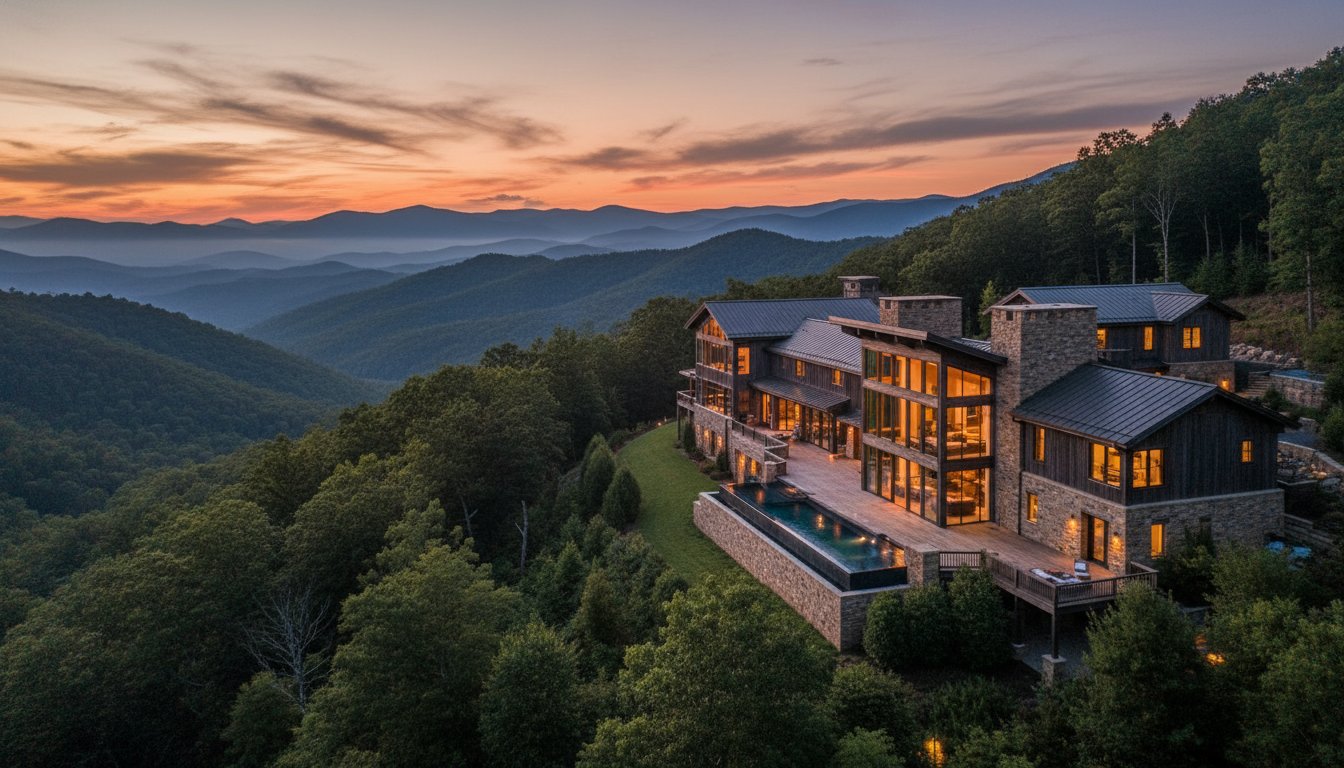
The era of the real estate “frenzy” has passed, yet the North Carolina High Country remains one of the most compelling regions for wealth preservation in 2026. The market is rebalancing. Demand remains high. While some investors hesitate amidst shifting interest rates, savvy capital is moving into the Blue Ridge Mountains as a strategic hedge against urban volatility. A sophisticated NC real estate investment in towns like Blowing Rock or Banner Elk offers more than just a lifestyle; it provides a tangible asset in a market where 45% of buyers are now closing in cash.
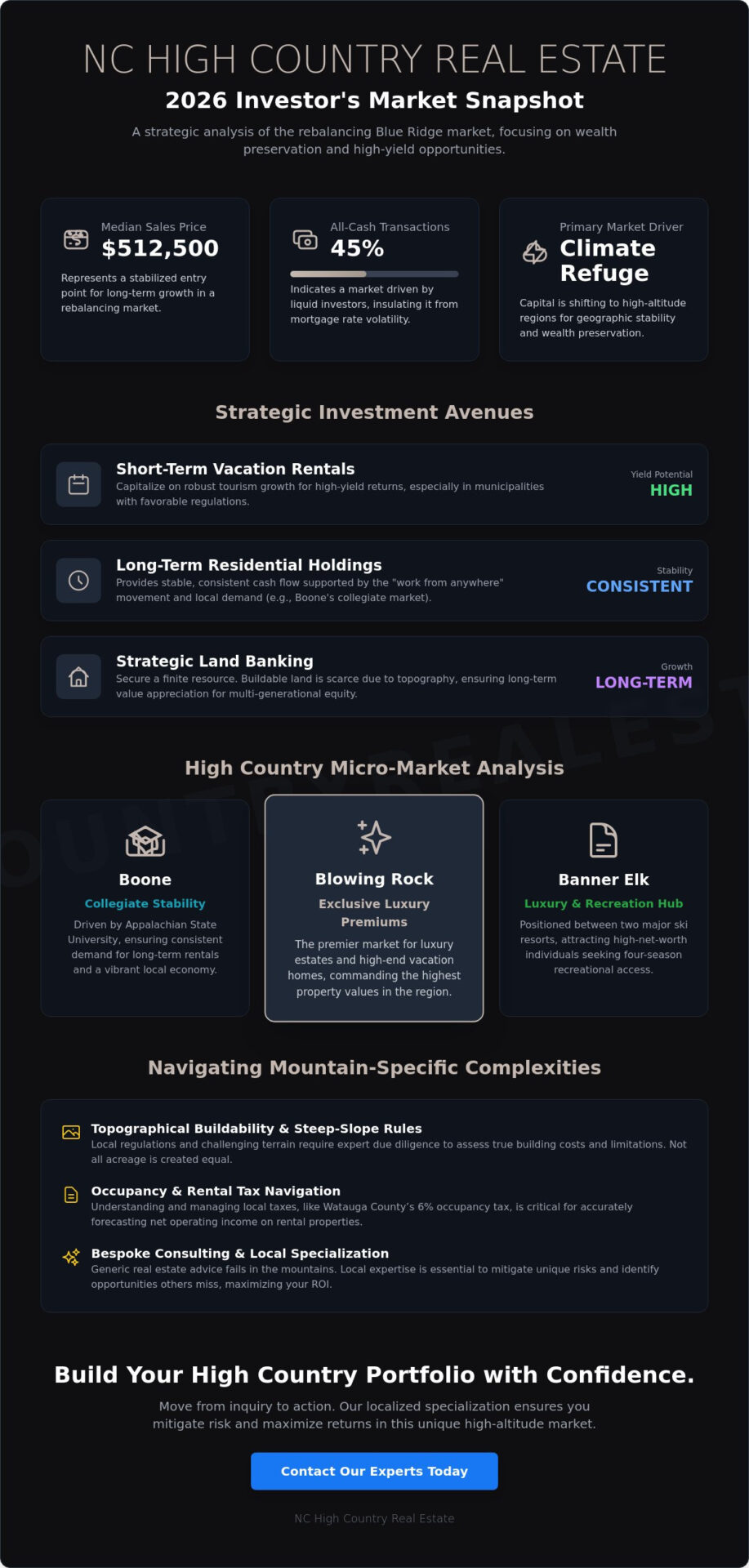
You likely recognize that mountain property carries unique complexities, from managing Watauga County’s 6% occupancy tax to understanding the topographical nuances of steep-slope construction. It can feel daunting. This guide ensures you move from inquiry to absolute confidence by detailing the specific market drivers and regulatory shifts defining this year. You’ll discover the highest-yield municipalities for seasonal rentals, learn the essential due diligence steps for Blue Ridge acreage, and see why the current median sales price of $512,500 represents a stabilized entry point for long-term growth.
Key Takeaways
- Understand the “Climate Refuge” effect and why capital is shifting toward the Blue Ridge Mountains as a primary wealth preservation tool in 2026.
- Explore diverse strategies for NC real estate investment, ranging from high-yield short-term rentals to strategic long-term land banking.
- Identify the specific drivers within local micro-markets, including the collegiate stability of Boone and the exclusive luxury premiums of Blowing Rock.
- Learn the critical due diligence steps unique to mountain terrain, specifically regarding steep-slope construction and topographical buildability.
- Discover how bespoke consulting and localized specialization can mitigate risk and maximize ROI in a rebalancing high-altitude market.
Why NC Real Estate Investment is Trending Toward the High Country in 2026
The real estate landscape has fundamentally shifted this year. While the high-velocity “frenzy” of previous seasons has cooled, the demand for high-altitude assets has only intensified. Investors are now prioritizing long-term stability over rapid, speculative flips, leading to a sophisticated influx of capital into the High Country. Unlike the saturated urban markets of Raleigh or Charlotte, where inventory remains tight and yields are compressed, a strategic NC real estate investment in the Blue Ridge offers a unique combination of lifestyle appeal and asset resilience. The market is currently rebalancing, providing a window of opportunity for buyers to secure premium properties at a median sales price of $512,500 as of April 2026.
One of the most significant drivers of this trend is the “Climate Refuge” effect. Large-scale institutional and private capital is increasingly moving toward the Western North Carolina region because of its geographic elevation and perceived resilience to coastal volatility. This isn’t just about escaping the summer heat; it’s a calculated move to place wealth in a region with sustainable growth patterns and a permanent shift toward outdoor-centric living. Tourism growth in the High Country continues to outpace many other rural sectors, which directly supports property values and ensures that high-end mountain estates remain highly liquid assets.
The Resilience of the Blue Ridge Market
Mountain properties have historically demonstrated a remarkable ability to hold value during broader economic fluctuations. In 2026, High Country real estate resilience is defined by a market that has transitioned from a speculative frenzy into a disciplined, value-driven environment where quality assets consistently command a premium. This stability is largely due to the scarcity of buildable land. Unlike flatland developments that can expand indefinitely, the topography of the Blue Ridge creates a natural ceiling on supply. When you invest in land and acreage sales here, you aren’t just buying dirt; you’re securing a finite resource that benefits from perpetual scarcity.
Lifestyle as an Investment Driver
The “work from anywhere” movement has matured into a permanent cultural fixture. We’ve seen a clear transition where vacation homes in Boone and Blowing Rock are becoming semi-permanent residences for professionals who value discretion and natural beauty. This shift has elevated the standard for luxury estate sales in the area. Buyers aren’t just looking for a weekend getaway; they’re looking for sophisticated properties that can serve as a primary base. This intersection of high-end mountain living and strategic wealth preservation makes NC real estate investment a preferred choice for those who want their portfolio to reflect their lifestyle priorities. The presence of 45% cash buyers in early 2026 confirms that this market is driven by serious, liquid investors rather than debt-reliant speculation.
Strategic Avenues for Investment: STRs, Long-Term Rentals, and Land Banking
Success in NC real estate investment requires more than just capital; it demands a granular understanding of how different asset classes perform in a high-elevation environment. The current North Carolina economic outlook for 2026 suggests a steady trajectory for the state, yet the High Country operates within its own micro-economic climate. Investors today are diversifying across short-term vacation rentals, long-term residential holdings, and strategic land banking to capture both immediate yield and multi-generational equity. Each avenue presents distinct advantages depending on your risk tolerance and desired level of involvement in the mountain market.
Luxury mountain estates remain the premier high-barrier-to-entry asset. These properties, often situated at elevations exceeding 4,000 feet, command a significant premium due to their exclusivity and the sheer difficulty of replicating their views and craftsmanship. For the sophisticated buyer, these estates represent more than a residence. They’re a vehicle for significant equity potential in a region where 45% of transactions are executed in cash, insulating the upper-tier market from broader mortgage volatility.
Navigating the Short-Term Rental Landscape
The short-term rental (STR) market is a cornerstone of the High Country economy, but it’s no longer a “set it and forget it” endeavor. In 2026, regulatory precision is vital. For instance, the Town of Boone requires a $530 annual permit fee for whole-house vacation rentals, while Banner Elk maintains a $300 initial application fee with a $40 annual renewal. Revenue potential varies significantly by location; properties near ski resorts in Avery County often see peak winter demand, while riverfront locations in Watauga County maintain high occupancy throughout the summer and autumn. Before acquiring a property, reviewing a comprehensive NC mountain vacation homes for sale resource can help you identify which municipalities offer the most favorable zoning for your investment goals.
The Case for Land and Acreage
Strategic land banking in the High Country acts as a powerful hedge against inflation, as the finite supply of mountain-view acreage creates a natural floor for valuation regardless of currency fluctuations. Unrestricted land in Ashe County has become a high-demand asset for those looking to secure future build sites or preserve “view sheds” that will only increase in value as neighboring parcels are developed. When evaluating acreage, we prioritize river access and topographical orientation. These features are impossible to manufacture and serve as the primary drivers for long-term appreciation. If you’re looking to identify specific parcels with high development potential, a customized consultation through nchighcountryrealestate.com can provide the localized data necessary to make an informed acquisition.
Analyzing High Country Micro-Markets: Boone, Blowing Rock, and Banner Elk
The High Country is not a monolith. It’s a sophisticated tapestry of micro-markets, each offering a distinct profile for NC real estate investment. While the region as a whole benefits from the “rebalancing” trends of 2026, your success depends on matching your capital to the specific municipality that aligns with your financial objectives. From the collegiate energy of Boone to the refined elegance of Blowing Rock, the nuances of local demand dictate your eventual ROI.
Boone serves as the region’s economic engine. Driven by Appalachian State University and a robust regional healthcare sector, this market offers unparalleled stability for residential property sales. Unlike seasonal vacation towns, Boone maintains high occupancy rates year-round. Conversely, Blowing Rock, often called the “Crown of the Blue Ridge,” remains the premier destination for luxury estate sales. It’s a market defined by prestige and historical significance, where properties often trade hands within private circles before ever hitting the public market.
Further west, Banner Elk and Beech Mountain leverage the seasonal peaks of the ski industry. These areas are ideal for investors targeting the high-velocity vacation rental market. Meanwhile, West Jefferson and Ashe County have emerged as the frontier for those seeking more accessible entry points into mountain real estate. This area has seen a surge in interest from buyers looking for larger acreage and land sales, offering a pastoral alternative to the high-altitude density of the resort towns.
Boone vs. Blowing Rock: Which Fits Your Strategy?
Choosing between Boone and Blowing Rock requires a clear understanding of your target tenant. Boone’s market is anchored by a consistent need for student and workforce housing. If you’re looking for predictable, long-term residential yields, homes for sale in Boone, NC provide a reliable foundation. Blowing Rock attracts a high-end vacationer who prioritizes proximity to Main Street and the Blue Ridge Parkway. Tax considerations also play a role. Watauga County’s 2025-2026 tax rate is 0.318 per $100 of valuation, but the effective tax rate in Boone sits at 0.41% due to municipal assessments. Understanding these fractional differences is essential for accurate ROI projections. For investors specifically targeting the town’s elite rental districts, a detailed review of Blowing Rock investment property opportunities in 2026 can clarify which zones permit short-term rentals and where the highest-yield assets are currently concentrated.
The High-Altitude Appeal of Banner Elk
Banner Elk is a favorite for second-home investors seeking dual-season income. The town bridges the gap between Sugar Mountain and Beech Mountain, making it the epicenter of North Carolina’s winter sports. In 2026, we’ve seen a notable trend toward luxury condos that offer “lock-and-leave” convenience for seasonal residents. Avery County maintains a tax rate of 0.40 per $100, which remains competitive for the region. The influence of exclusive private clubs, such as Elk River and Diamond Creek, creates a “halo effect” on nearby property values. With the median home price in town reaching $1.04 million as of April 2026, investors asking is Banner Elk a good investment will find a data-driven case for its resilience and long-term equity potential. Investing near these established communities often provides a buffer against market volatility, as the high-status markers of the area continue to attract elite buyers looking for seclusion without sacrificing amenities.
Navigating the Unique Challenges of NC Mountain Property Investment
A successful NC real estate investment in the High Country requires a departure from standard flatland due diligence. You aren’t just buying a structure; you’re acquiring a piece of complex geology. This is where many out-of-state investors stumble. They assume a standard home inspection covers the essentials, but mountain properties demand a more rigorous investigation into the ground beneath the foundation. We guide our clients through a bespoke inspection process that accounts for the specific environmental stressors of the Blue Ridge region.
Understanding topography and buildability is the first step in protecting your capital. The cost to build on a steep slope can be significantly higher than on level ground due to the need for advanced retaining walls and specialized engineering. If you’re looking at land and acreage sales, the “perk test” is the most critical document you’ll ever sign. In our rural corridors, municipal sewer is rare. A soil suitability test determines if the land can support a septic system; without a valid permit, a ten-acre parcel is essentially a very expensive park.
Zoning and HOA regulations also present unique hurdles. Identifying rental restrictions is paramount before you commit to a purchase. As we’ve seen in 2026, the Town of Boone requires a $530 annual permit for whole-house vacation rentals, while Banner Elk charges a $300 initial fee. Beyond municipal laws, many luxury communities have private covenants that may restrict or even ban short-term rentals. We meticulously review these documents to ensure your NC real estate investment aligns with your intended use.
The Logistics of Mountain Ownership
Road maintenance is a central concern that many newcomers overlook. In the High Country, many secondary roads are private, meaning homeowners are responsible for snow removal and gravel replenishment. We always review the Road Maintenance Agreement to see who pays and how the work is managed. It’s also vital to distinguish between “unrestricted” and “restricted” land. Unrestricted land offers maximum flexibility, while restricted parcels often come with architectural guidelines that preserve the neighborhood’s aesthetic and value. Environmental surveys are a wise investment to protect against unforeseen runoff issues or soil instability.
Risk Mitigation and Insurance
Mountain-specific insurance requires a localized, intimate perspective. You must account for fire protection ratings in remote areas and potential flood zones in valley floors. The #1 mistake investors make is underestimating the hidden costs of erosion control on properties where they ignored the natural drainage patterns of the local topography. While we specialize in investment property sales, we strongly advise remote investors to secure professional local property management to handle the physical realities of mountain weather. To ensure your due diligence is handled with surgical precision, consult with a High Country investment specialist today.
Building Your High Country Portfolio with Local Expertise
Local knowledge is the ultimate currency in this market. While automated valuation models might offer a broad overview, they consistently fail to capture the granular details that determine the actual value of a mountain asset. A successful NC real estate investment requires an advocate who understands the subtle differences between a property with a seasonal view and one with a permanent, protected vista. We don’t just facilitate transactions. We act as a strategic partner, providing bespoke consulting that aligns with the sophisticated needs of luxury and investment buyers.
The Lori Eastridge approach is built on a foundation of local network dominance. Many of the most lucrative opportunities in the High Country never reach a public listing. Through deep-rooted regional connections, we provide our clients with access to off-market estates and land parcels that offer superior equity potential. This insider access is particularly vital in a market where 45% of buyers are closing in cash, creating a competitive environment where speed and information are paramount. As you transition from a single property to a diversified High Country portfolio, having a partner who can identify these quiet opportunities becomes your greatest competitive advantage.
The Value of Specialized Representation
Professional industry designations aren’t just acronyms; they’re a signal of elite expertise and a commitment to excellence. Holding certifications such as the Certified Luxury Home Marketing Specialist (CLHMS) and the Resort and Second-Home Property Specialist (RSPS) allows us to translate complex market data into better negotiation outcomes for you. These credentials provide a framework for handling high-stakes mountain transactions with the discretion and personalized care they deserve. Whether you’re managing the requirements of Luxury Estate Sales or securing a high-yield rental, our specialized representation ensures your interests are protected at every elevation.
Next Steps for Your NC Investment Journey
Beginning your search requires more than just browsing listings. It starts with a custom consultation to define your specific financial objectives and risk tolerance. We help you develop a rigorous criteria list for your ideal mountain investment, accounting for everything from topography to municipal rental regulations. Whether you’re targeting the $512,500 median entry point or seeking a legacy estate, we provide the localized data necessary to move forward with confidence. We invite you to connect with us for a personalized market analysis that explores the current potential of your NC real estate investment goals in the Blue Ridge.
Securing Your Position in the Blue Ridge Mountains
The High Country is no longer a hidden gem; it’s a strategic destination for those who value asset resilience and geographic elevation. Success in 2026 requires moving beyond general market data and embracing the technical nuances of mountain topography and localized zoning. Whether you’re targeting the collegiate stability of Boone or the exclusive luxury of Blowing Rock, your entry point must be calculated and informed. Mountain markets reward the prepared.
A high-performing portfolio depends on having a strategic advocate who understands the complexities of Watauga and Ashe County markets. As a Broker/Owner with specialized luxury and resort certifications, Lori Eastridge provides a bespoke consultancy approach that standard agencies simply can’t match. You deserve a partner who prioritizes discretion and possesses the “insider” network required to secure off-market opportunities. Start your NC real estate investment journey with Lori Eastridge to gain the clarity and confidence needed for high-stakes mountain transactions. Let’s build your legacy here together.
High Country Investment: Frequently Asked Questions
Is the NC High Country real estate market still growing in 2026?
The market is currently in a phase of healthy rebalancing. While the high-velocity frenzy of previous years has subsided, the median sales price reached $512,500 in April 2026, showing sustained value growth. Inventory increased by 6.8% in early 2026, giving buyers more room to negotiate while demand for high-altitude assets remains a permanent trend.
What are the best towns for short-term rental investment in North Carolina?
Banner Elk, Blowing Rock, and Boone are the premier locations for a strategic NC real estate investment. Banner Elk offers dual-season appeal due to its proximity to Sugar and Beech Mountains. Blowing Rock commands a luxury premium for high-end vacationers, while Boone provides a stable mix of student, medical, and tourism demand throughout the year.
How do short-term rental restrictions work in the NC mountains?
Regulations are determined at the municipal level rather than by the county alone. For example, the Town of Boone charges a $530 annual permit fee for whole-house rentals. In contrast, Banner Elk requires a $300 initial application fee. Both Watauga and Avery counties levy a 6% occupancy tax on short-term stays, which must be factored into your yield calculations.
What is the average ROI for a vacation rental in Boone or Blowing Rock?
Revenue potential is driven by the region’s year-round tourism cycle rather than a single peak season. Properties in Blowing Rock benefit from high-end summer and leaf-season traffic, while Boone maintains consistent occupancy through university events and regional healthcare needs. Accurate ROI projections must account for local occupancy taxes and the specific maintenance costs associated with mountain weather.
Do I need a special type of financing for an investment property in the High Country?
Financing follows standard secondary market guidelines, though the High Country sees an unusually high volume of liquidity. Approximately 45% of transactions in early 2026 were cash purchases. For those utilizing leverage, 30-year fixed mortgage rates currently fluctuate between 6.31% and 6.375% as of May 2026, depending on your credit profile and down payment.
What should I look for when buying land for investment in NC?
Prioritize topography, soil suitability, and legal access. A perk test is essential to ensure the land can support a septic system, as municipal sewer is rare in rural areas. You should also verify road maintenance agreements to determine who is responsible for snow removal and gravel upkeep, as these costs can impact your long-term holding strategy.
How does the “Due Diligence” period work in North Carolina real estate?
The Due Diligence period is a unique North Carolina process where the buyer pays a non-refundable fee directly to the seller. This fee grants you the right to terminate the contract for any reason before the period expires. In the mountains, this window is vital for conducting environmental surveys and steep-slope buildability assessments before your capital is fully committed.
Why is it better to invest in the High Country over coastal NC properties?
The High Country offers a “Climate Refuge” advantage and a more consistent year-round tourism season. Unlike coastal properties that face significant hurricane risks and rising insurance premiums, mountain estates provide a strategic hedge against coastal volatility. The Blue Ridge region benefits from four distinct seasons of rental demand, from winter skiing to summer hiking.
